
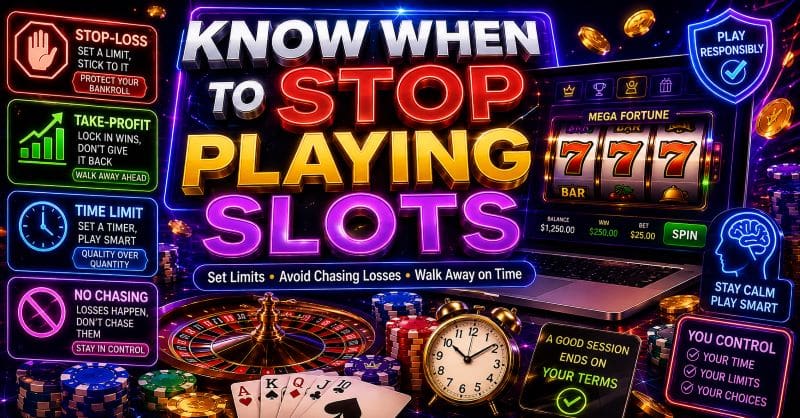
The hardest part of learning when to leave a slot is understanding that there are ways to lose money at a slot without realizing it. When you go to a slot, and sit down to “just spin for a little,” the lights flash, the music plays, and before you know it, forty-five minutes have passed and you’re still spinning; you’ve used less money than you wanted to, and you wonder how the time slipped away. That’s the gap between what you thought you were going to do, and what actually happened. All of us beginners have been there. Learning when to stop playing a slot has nothing to do with being paranoid or joyless. It’s a skill — the same type of skill that comes with knowing when to fold a poker hand, or close a web browser. As with most skills, it takes some experience before we can identify the signs we are looking for.
Some of these signs may seem obvious to those who understand how Slots work, but they are often overlooked by the beginner. Some examples include:
1. The five-minute lie
No one sits down to play a slot thinking they’ll spend two hours. They always start with something small: “let me try this new game,” or “five minutes before dinner.” Slots are built to eliminate that intent. The game moves quickly; the near misses come frequently; and there is no inherent ending to the game as there is in a hand of blackjack where you have to make a choice after it ends. If you’ve ever opened an app “to spin for five minutes” and found that an hour had passed, it’s not because of a lack of will power; it’s because the app was working as it was designed.
The solution isn’t to increase will power as we engage in the game longer and our brain is flooded with dopamine. The solution is to create a predetermined boundary for ourselves before we open the app: a session budget and a set amount of time we allow ourselves to be engaged. That’s how we remove the decision from a time when we’re least capable of making good decisions.
2. Math based upon your session budget
This is the area beginners ignore most often, and it is also the best indicator of whether you will complete your session or continue to gamble. Before loading any credits onto your account determine two things: how much are you willing to lose (stop-loss), and how much profit would make you satisfied to walk away from the slot (take-profit)? Why does this matter? Because Slots have no natural end point, and your brain is poor at determining when it has reached its maximum allowable loss during the course of a session. Therefore, you need to establish your boundaries prior to beginning your gaming session.
Responsible gaming limits are established in such a manner because they are determined while you’re in a “cold” state of mind, and enforced regardless of how your “warm”, in-the-moment state of mind feels about it. In other words, if you reach your pre-established stop-loss or take-profit limit during your session, you cease all gaming. Not “one more spin to see”! These boundaries are placed in order to protect your bankroll. Once you begin ignoring them because they become inconvenient, that is when they begin to perform their function properly. The same principle applies to topping off your deposit mid-session.
If you find yourself adding additional deposits while you’re in the middle of your session because you didn’t add enough initially, that is not simply bad luck requesting additional funding; that is the plan you created being replaced by your current emotions. If you receive a request from yourself to add additional funds mid-session, recognize it as a signal to stop – not as a signal to add more funds.

3. The game no longer feels good
Slot machines are entertainment first mathematically speaking. Entertainment is supposed to be enjoyable. Therefore, one of the easiest indications of when it is time to stop playing Slots is when it ceases to feel enjoyable. If, during a series of consecutive losses, you detect growing irritation and/or frustration, if your jaws tighten and you begin clicking the spin button more forcefully than necessary — these indicate that your body has signaled that this activity has transitioned from entertainment to problems. At this juncture, the cost/benefit analysis portion of your brain will typically withdraw from consideration, allowing more impulsive parts of your brain to assume control.
This is generally the point when Chasing begins although you may not acknowledge it as such at the time. You will tell yourself that you’re merely “getting back even,” which appears logical in retrospect. However, getting back even is simply an arbitrary number your brain arbitrarily assigns to your recent history; it holds no mathematical significance whatsoever. By this stage of play, winnings fail to elicit any positive sensations; the thrill associated with winning has dissipated; and you’re merely mechanically clicking through spins without generating any emotional response.
Many beginners interpret this state as calmness as if they have finally achieved a sense of peace regarding their gaming experience. More likely than not, however, this represents reward desensitization wherein your body has acclimated to the stimulus provided by the slot machine(s); therefore, you require increasingly greater stimuli (larger bets, longer gaming sessions, faster paced games) in order for any sensation at all to occur. The dull sensation you perceive and the likelihood that it goes undetected — is sufficient justification for attending to it.
4. Autopilot is not a strategy
There exists a specific, identifiable state that develops once an individual has played Slots for an extended period of time; namely, when their hands remain pressing the spin button but their minds are elsewhere. Decision-making ceases. You’re no longer intentionally continuing to play; you’re simply continuing as you would scroll through an endless feed without actively engaging with it. Fatigue contributes significantly to this condition. Impaired cognitive ability resulting from tiredness and distractions affects decision-making processes without producing overtly negative reactions, i.e., “I’m making a mistake now!”
Bet sizes increase incrementally each step representing an acceptable adjustment (e.g., from your standard betting level to slightly larger bets, and then slightly larger bets once again) and it is only upon reviewing your session results that the incremental increases become apparent. If you discover yourself progressively raising bet sizes with no basis in your initial intentions or plans, regard this as an indication that you should immediately cease all gaming activities.
“I want to reach my take-profit target” represents a clear response whereas “I don’t know … I guess I just still am doing it” indicates autopilot has assumed control and this signifies that the gaming session should have concluded previously.
5. Chasing losses: point of no return
All of the indicators outlined thus far are relevant; however, none compare in importance to Chasing losses. For this reason, Chasing losses warrants its own distinct classification — separate from bankroll considerations. Chasing losses is potentially disastrous because it transforms what began as a disappointing gaming session into one which truly creates problems. When you raise bets or extend your gaming session solely for the purpose of recovering funds previously lost, you have entered problem-gaming territory regardless of whether you consider this shift dramatic or not at the moment.
The rationale underlying Chasing losses seems logical at the time: “I’ve already lost x dollars…so why not keep playing until i recover that amount?” or “after y consecutive misses i am due for a win.” neither scenario accurately describes how independent random events operate; nevertheless, both appear realistic because losses trigger loss-aversion a documented phenomenon in behavioral finance whereby individuals give more weight to losses relative to equivalent gains which motivates individuals toward increased-risk behavior specifically when attempting to mitigate losses incurred heretofore.
Slot machines represent strings of independent random events; therefore, the machine retains no knowledge of your previous fifty gaming outcomes and provides no benefit based on those outcomes. Cognitive decision-making misleads you into believing differently, which explains why establishing non-negotiable predetermined stop-loss limits (as described in item #1) requires an honest acceptance that the house edge remains constant regardless of your last twenty gaming experiences — and that quitting when the fun stops occurs regardless of whether you are presently winning or believe you owe yourself a win.
That second aspect deceives individuals more frequently than the first aspect does. Quitting while losing is easily identified upon reflection — albeit after it’s occurred. Quitting while winning — prior to the eventual return to randomness of winning and losing — is considerably more difficult in terms of discipline, and this is exactly what a take-profit target is established to enforce.
6. Larger than one gaming session
Many of the indicators referenced above relate primarily to individual gaming sessions. However, there is an important category of warning indicators that pertain to patterns developed over weeks/months/years — rather than isolated incidents within a single gaming session. Since these are particularly prevalent among beginners, they deserve special attention because they necessitate responses differing from “take a break tomorrow”. Examples include:
- Making excuses for under-reporting either time or money devoted to gaming — regardless of size.
- Borrowing money exclusively for the purpose of continuing gaming (credit cards/cash advances/friends).
- Gaming for reasons other than enjoying oneself (stress relief / boredom / etc.)
- Feeling anxious/restlessness on days in which one does not intend to play.
- Repeated failures attempting to reduce/reduce gaming frequency.
These behaviors collectively form evidence of addiction-type symptoms — rather than habits requiring tighter controls — and they warrant seeking help from support groups specifically addressing gambling-related issues (not generalized mental health assistance lines).
Most licensed websites maintain self-exclusion programs; furthermore, numerous organizations specializing in supporting victims of problem gambling exist for the express purpose of providing help for such situations. There is no stigma associated with utilizing these services; in fact, much of the stigma surrounding this issue prevents individuals from disclosing their difficulties in the first instance.
7. Building an effective beginner exit strategy from Slots
None of the indicators discussed above will prove useful unless accompanied by an effective plan for exiting gameplay — and an effective exit strategy relies upon having predetermined goals in place before entering gameplay. Thus, having an effective exit strategy should be dependent upon setting specific criteria for your exit strategy rather than relying upon vague notions of behaving “carefully.”
Several specific strategies make this practical:
- Set your desired loss limit and winning goal prior to depositing any funds — as opposed to stating vague amounts such as “not too much.”
- Establish a countdown timer for your desired gaming session duration and treat each subsequent alarm as an absolute requirement for terminating gaming activities rather than as mere suggestions.
- Determine beforehand that any impulse to replenish funds mid-session constitutes an immediate exit criterion — rather than an acceptable request.
- Periodically assess how you are actually experiencing yourself throughout each gaming session (approximately every 20 minutes) since frustration and/or being on autopilot both develop gradually rather than announcing themselves.
- If you find yourself rationalizing away any of items #1-#5 above, treat that rationalization process as the strongest indicator possible since it generally implies that your pre-game planning has already begun deviating from reality.
The final word for newcomers to Slots
Slot machines are engineered to retain gamers’ interest; hence, there is absolutely nothing inherently wrong with this design objective per se — so long as gamblers establish their own limits for termination of playtime prior to commencing gaming activities. The critical factor is ensuring that gamblers carry their own termination points into play along with them since there exists no provision built-in by virtue of how slot games function that will automatically terminate gameplay at some predetermined point in time.
Monitor your budget; monitor your moods; monitor whether you are gaming because it is entertaining versus whether you cannot bring yourself to discontinue gaming activities at present. Gamers who find themselves playing Slots without remorse do not necessarily have unblemished records devoid of loss; they are those who are aware of when to terminate their slot-machine usage — regardless of their status as winner or loser adhere strictly to their limits — and abandon their seat prior to experiencing any further enjoyment as anything other than entertainment.